

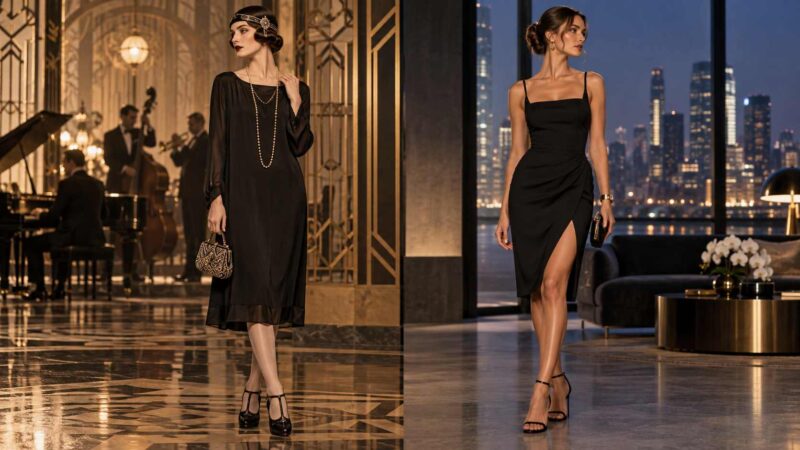
Few clothes have managed to be both a fallback and a fashion icon for so long. Little black dresses are often what people reach for when every other outfit starts asking too many questions.
Fashion asks people to keep changing their minds, while a good little black dress quietly offers one less decision to make.
In this article
1926 Gave Black a New Job
October 1926 is usually treated as the little black dress’s big arrival.
American Vogue published an illustration of Coco Chanel’s straight, long-sleeved black dress in unlined crêpe de chine. Four diagonal lines decorated its simple silhouette.
Vogue nicknamed it “Chanel’s Ford,” comparing it with the Model T, a car associated with mass accessibility rather than exclusivity. Editors predicted that the design would become a kind of uniform for fashionable women.
Victorian mourning customs had strongly tied the color to grief, loss, and social rules about how long bereaved women should dress in dark clothing.
Chanel helped strip that older meaning away, especially in simple daywear, recasting black as modern, streamlined, and socially flexible.
Credit still needs some correction. Chanel did not invent women wearing black dresses. Her contribution was closer to popularization, timing, and cultural reframing.
A black dress already had a long life before Vogue decided it looked modern.
Before Chic, Black Meant Work
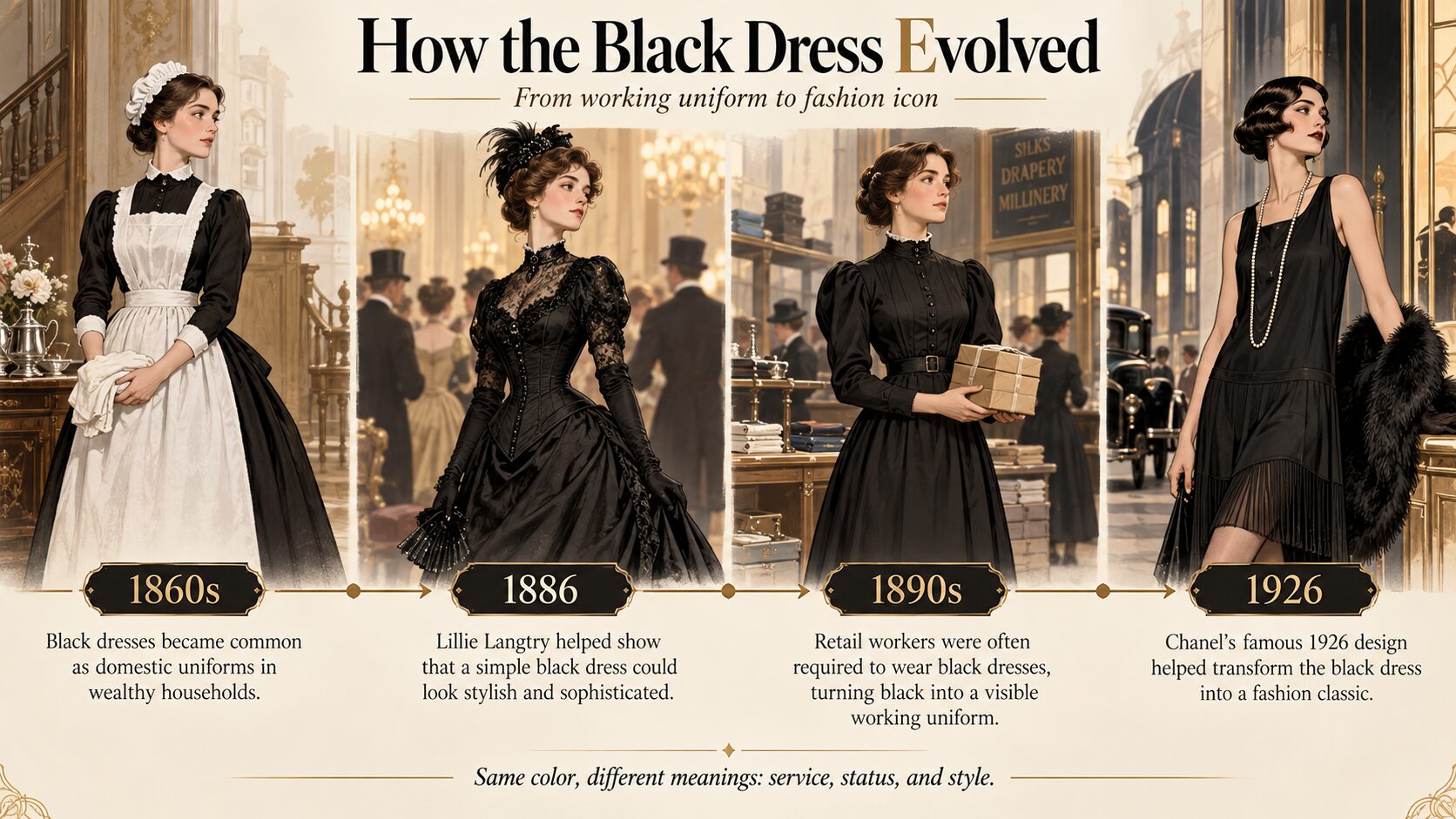
By the 1860s, wealthy British households increasingly expected maids to wear a simple black dress with a white cap and apron. Clothing made rank visible at a glance. Mistress and servant could occupy the same room, but nobody was meant to confuse their positions.
Similar rules appeared in retail. By the 1890s, shopgirls in New York, London, and Paris were also being required to wear black dresses.
Some workers objected because the clothes marked them publicly as working women. Black was neat, practical, and easy for employers to standardize, but it also functioned as a social label.
Fashionable women, meanwhile, had already started borrowing the look.
Actress and society figure Lillie Langtry attracted praise in 1886 for wearing a simple black frock, four decades before Chanel’s Vogue moment.
So when Vogue called Chanel’s 1926 design a uniform, it accidentally touched a much older history. Black had already been a literal uniform for working women.
Fashion did not invent that simplicity. Fashion changed who could wear it and what that simplicity was allowed to communicate.
On a maid, a plain black dress could signal service and class. On a society woman, similar restraint could read as confidence, taste, and modernity.
Same color, similar simplicity, very different social meaning.
Hollywood Made Simplicity Look Expensive
Audrey Hepburn’s Givenchy dress in “Breakfast at Tiffany’s” became perhaps the most recognizable little black dress in popular culture.
Long gloves, pearls, dark glasses, and an elegantly narrow silhouette turned black simplicity into a complete visual code. One version of the dress sold at Christie’s in 2006 for £467,200.
No single image explains the category, though. Catherine Deneuve wore a prim Saint Laurent black dress in “Belle de Jour”.
Elizabeth Hurley arrived at a 1994 premiere in Versace’s safety-pin dress, a black gown held together with oversized gold pins and almost no interest in modesty.
Both count as little black dresses.
That flexibility is the point. “Little black dress” sounds like a tightly defined item, but the category has always had generous borders.
Fabrics get heavier, softer, shinier, or more transparent. Necklines can be severe or dramatic.
Yet black keeps the idea recognizable.
Timelessness, in practice, often means being adaptable enough to survive other people changing the rules.
Why a Black Dress Still Feels Like a Safe Answer
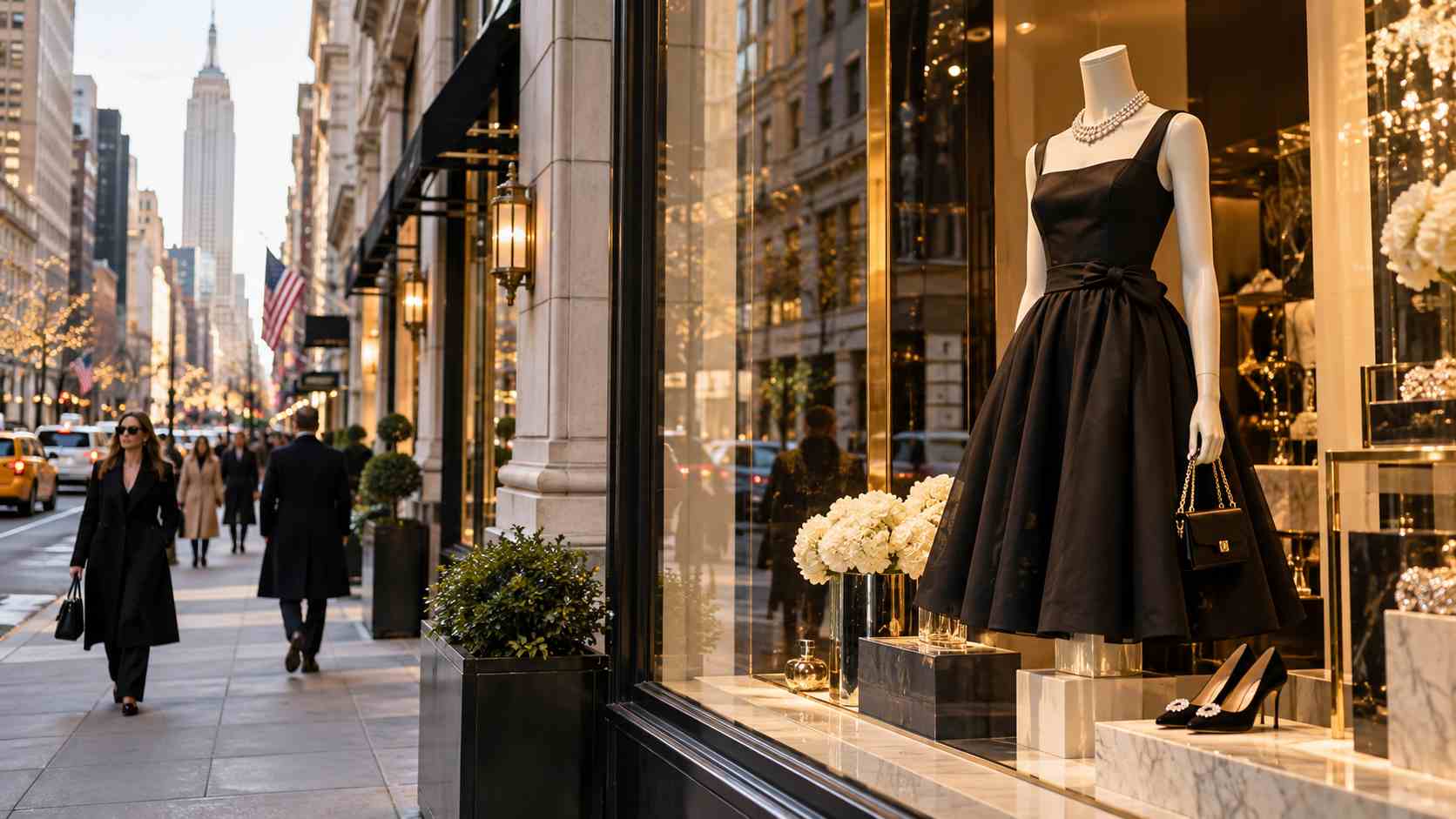
A little black dress works almost like a blank page. Cut, neckline, sleeves, shoes, jewelry, and outerwear can change its personality without making the basic garment feel unfamiliar.
One version can look appropriate at work, another at dinner, another at a cocktail party, and another at an event where everyone has spent too long decoding “elevated casual.”
Faster trend cycles may even make an LBD more useful.
Social media can turn a color, neckline, shoe, or silhouette into a must-have and then retire it before some people have removed the tags.
Black offers a small escape hatch. A well-cut dress can stay useful even when the accessories around it change.
Decision fatigue matters here more than fashion history usually admits. People often want an outfit that makes them feel pulled together without requiring a committee meeting in front of the mirror. A familiar black dress can do exactly that.
“Safe” can sound faintly insulting in style writing, as if every outfit should be an act of creative bravery.
Most people do not need every dinner reservation to become a costume experiment. Sometimes reliability is the feature.
A Uniform, Just Not in the Way Vogue Meant
Vogue’s 1926 prediction turned out to be remarkably accurate. A simple black dress did become a uniform for fashionable women.
Working women had already worn black uniforms for decades before Chanel’s dress appeared in print.
Later generations simply chose the uniform for themselves and attached a new set of meanings to it.
Simplicity gives people room to project something onto it, while black keeps the whole thing difficult to mishandle.
A century after “Chanel’s Ford,” wardrobes are still full of louder options. Yet when an invitation makes all of them look suddenly wrong, black still tends to get the call.