

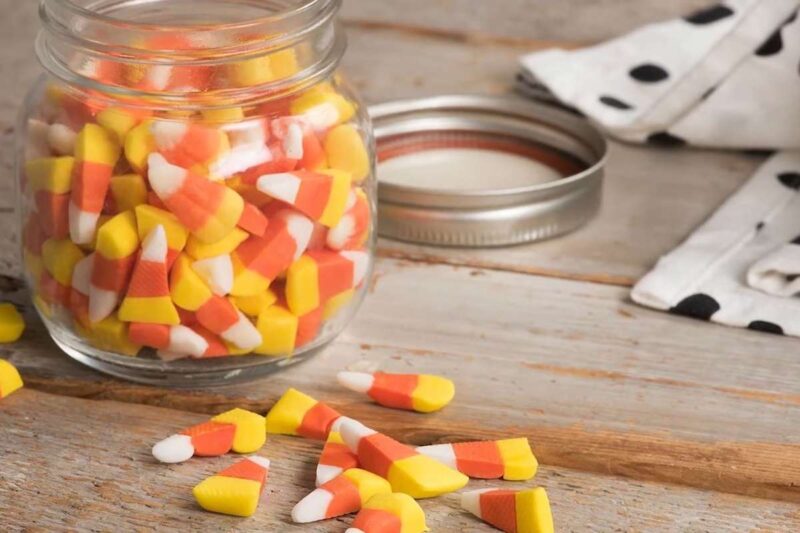
Honey, sugar, corn syrup, and that dense chew can feel comfortingly familiar to one person and like a seasonal practical joke to another. Yet taste is only half of what makes candy corn interesting. Its history is stranger than its reputation.
For a candy that looks like a tiny piece of corn, we have become surprisingly good at forgetting the corn part.
In this article
Before Halloween, There Was a Farm

Candy-making history generally credits George Renninger of Philadelphia’s Wunderle Candy Company with creating candy corn sometime in the 1880s.
Chestnuts, turnips, clover leaves, and other familiar shapes could all end up in a candy case. Seen in that company, a candy shaped like a corn kernel suddenly makes much more sense.
Modern shoppers are used to novelty sweets shaped like almost anything, but farm imagery had a particular commercial logic in that period.
Rural life was still close enough to everyday American culture that a confectionery vegetable patch did not need much explanation.
Color made candy corn different. Yellow, orange, and white were added in separate layers, creating the striped kernel that still identifies the candy instantly.
Early production required those colors to be added separately by hand, making a tiny candy surprisingly labor-intensive.
Nothing about that process required Halloween. Farm imagery was doing the selling.
Yes, It Was Once Called “Chicken Feed”
“Chicken Feed” may sound like the name a modern critic would invent after losing an argument about candy corn, but versions of the candy were actually sold under that name. Goelitz, a company later associated with Jelly Belly, leaned enthusiastically into the farm idea.
Packaging featured a rooster and the slogan “King of the Candy Corn Fields.” Marketing logic was basically: here is candy that looks like corn, so let us make the corn part impossible to miss.
Cultural associations around corn also looked different before World War I. Corn had stronger links with animal feed and inexpensive rural food than it would carry for many Americans later.
Calling a candy kernel “Chicken Feed” landed differently in that setting. A strange little reversal followed. Candy corn began as a sweet pretending to be chicken food.
Halloween eventually turned it into something that barely needs to pretend to be food at all. For plenty of people, it now functions just as happily as decoration.
Candy Corn Wasn’t Born for Halloween
Early candy corn spent much of its life as penny candy. Shops sold it loose or in bulk, and buyers did not need to wait until October to justify eating it. Seasonal associations existed, especially around harvest time, but one holiday had not yet claimed ownership. Advertising makes that easier to see. A 1951 ad promoted candy corn as something children could enjoy all year.
Kernel shape suggested harvest season, while yellow and orange already looked comfortable beside leaves, pumpkins, and other fall imagery. Other occasions could make room for it too. Thanksgiving tables, Easter assortments, parties, baking projects, and ordinary candy counters all had a place for candy corn at different points in its history.
Candy corn did not walk directly out of a Philadelphia candy kitchen and into a plastic jack-o’-lantern. Halloween had to claim it first.
How Halloween Claimed It
Halloween changed significantly during the mid-20th century as trick-or-treating became more widespread and packaged candy took on a larger role in the holiday.
Candy corn was conveniently prepared for distribution.
October advertising for it increased sharply beginning in the 1950s. Trick-or-treating created a growing market for inexpensive candies that could be handed out easily, and candy corn already came with colors that looked as if someone had designed them specifically for fall. Yellow, orange, and white did a great deal of work.
Repeated advertising did the rest. More October promotion meant more October purchases. More October purchases created stronger memories. Stronger memories helped turn a general sweet into something people expected to see at one specific point in the calendar. Traditions often look older and more deliberate after enough repetition.
Then Candy Became a Personality Test
Modern candy corn discussion tends to move quickly past mild preference. Office conversations can turn into miniature debates. Halloween rankings regularly produce an amusing contradiction, with candy corn showing up as a favorite in some places while also earning a prominent spot on least-favorite lists.
Both results can be true because candy corn does not inspire much neutrality. Sensory reasons are not hard to find. Its sweetness is intense.
Anyone who ate candy corn every October as a child may not experience it as a simple sugar-and-texture equation. Flavor arrives attached to costumes, school parties, plastic buckets, grocery-store displays, and the annual realization that somebody bought the giant bag again.
Perhaps We Like What Candy Corn Means More Than What It Tastes Like
Candy corn may be doing a second job now. Eating it is optional. Recognizing it is not. Its yellow-orange-white pattern has migrated into:
- Decorations
- Costumes
- Cakes
- Cookies
- Drinks
- Novelty products
- Seasonal displays
A person can dislike candy corn intensely and still know exactly what month a candy-corn-colored object is trying to suggest. Few foods manage that trick.
Pumpkins offer a useful comparison. October does not require everyone to crave plain pumpkin. Shape, color, memory, and ritual do much of the cultural work. Food becomes scenery.
Candy corn has reached a similar position because its visual identity may now matter almost as much as its flavor. Commercial success does not always require universal affection. Sometimes recognizability is enough. Candy corn may have achieved the strange luxury of no longer needing everyone to enjoy eating it.
Reinvention Keeps Trying to Escape October
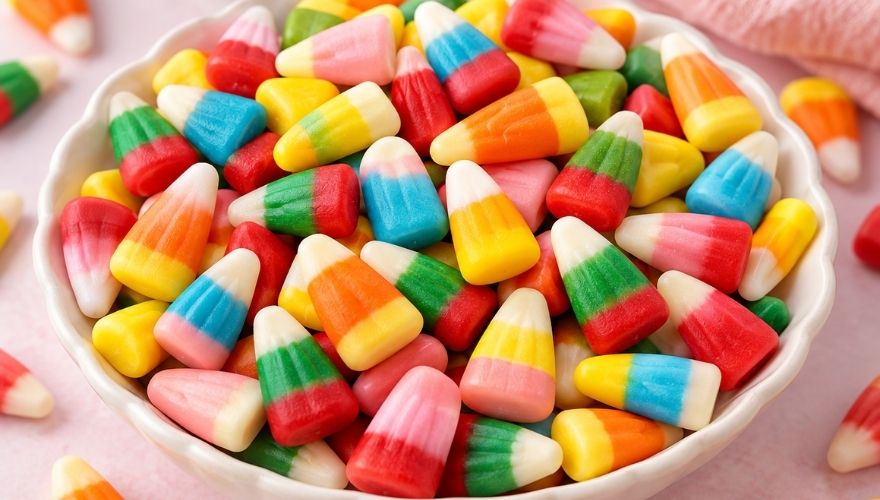
Manufacturers have repeatedly tried to loosen Halloween’s grip by giving candy corn new colors, flavors, and holiday identities. Easter versions have appeared as “bunny corn.”
Valentine editions, Christmas colors, and flavored variations have also tried to move the basic idea around the calendar.
Commercial logic is easy to understand. A product strongly associated with one month has a built-in sales problem during the other eleven.
Historical irony makes the effort better. Candy corn began as a general sweet, became tied almost exclusively to Halloween, and then had to be redesigned in an effort to become general again.
After spending decades teaching shoppers to think October, candy makers discovered the awkward side of succeeding too well.
A Candy That Outlived Its Original Meaning
Farmyard confectionery once made a candy kernel feel perfectly sensible. Most people buying candy corn today are not thinking about buttercream vegetables, rural marketing, penny-candy counters, or roosters printed on “Chicken Feed” packaging. Meaning changed while the shape barely did.
“Chicken Feed” became penny candy. Penny candy became an autumn treat. Autumn candy became a Halloween icon. Halloween candy became an annual argument with excellent name recognition.
Recipe details matter, especially if you are the person eating it. Cultural durability may be the more interesting achievement.
Back in the Halloween bowl, two outcomes are still waiting. Someone will pick out the candy corn first. Someone else will leave every piece until nothing better is left. Either person recognizes it immediately.
