
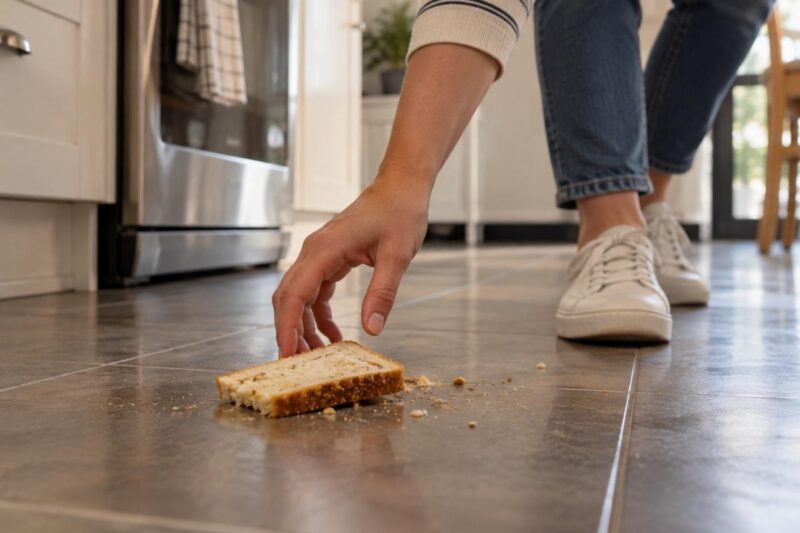
Drop a cracker, and there is a good chance your hand reaches for it before you have consciously decided anything.
Was it food-side down? Is the floor actually clean? Is it dry enough to pretend nothing happened? How much did that piece cost? Most important, did you beat five seconds?
Somewhere along the way, five seconds became the imaginary border between acceptable and disgusting.
Bacteria, inconveniently, never agreed to it.
In this article
Five Seconds Was Never a Force Field
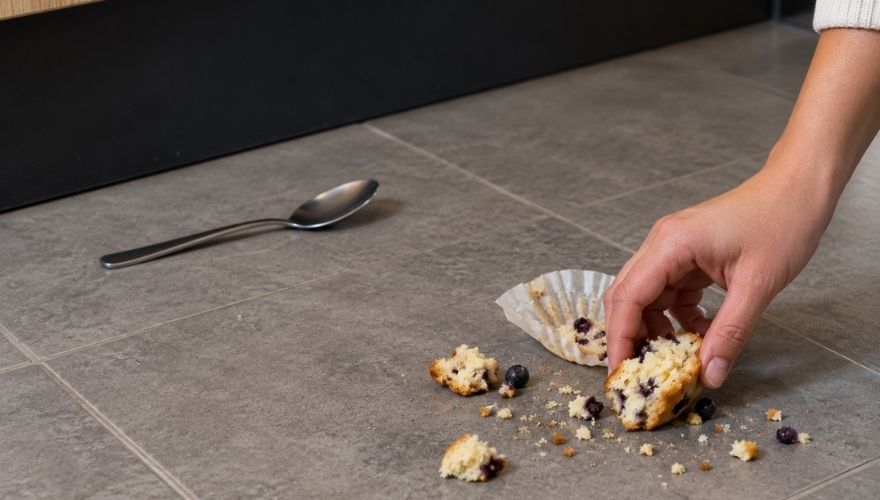
Popular logic gives dropped food a short grace period. Pick it up quickly enough and nothing bad has had time to happen.
Laboratory tests are considerably less sentimental.
Bacteria can transfer as soon as food touches a contaminated surface. No dramatic countdown is required. Experiments involving bread, bologna, tile, wood, carpet, E. coli, and Salmonella have repeatedly shown contamination inside the supposed grace period.
Rutgers researchers tested 128 combinations of food, surface, contact time, and bacterial preparation, repeating each one 20 times for 2,560 measurements. In some trials, bacterial transfer appeared in less than one second. Five seconds suddenly looks rather generous.
But, contact time still matters.
Food left on a contaminated surface longer can collect more bacteria, especially when moisture is involved. What studies fail to support is a neat threshold where seconds one through five are safe and second six suddenly becomes dangerous.
Five seconds is not a safety barrier. At best, it is the point at which you start feeling less optimistic.
That distinction matters because replacing one oversimplified rule with another would miss what makes dropped food interesting in the first place. Some foods really do pick up more contamination than others, even during the same short contact.
CBC News also put the five-second rule to the test in a video experiment. You can watch their test:
Moisture Changes the Calculation
Picture two foods landing side by side on tile.
One is a dry cracker. One is a slice of watermelon.
Both hit for three seconds. Both land on the same patch. Yet their chances of collecting bacteria are not equal.
Moisture helps microorganisms move between surfaces. Wet food creates more favorable contact, which is why high-moisture foods tend to pick up more bacteria during drop tests.
Watermelon performs especially badly in experiments comparing foods such as bread, buttered bread, gummy candy, and fruit. Wet food meeting a hard surface can create a particularly efficient transfer.
Across a large set of lab tests, bacterial transfer to watermelon ranged roughly 0.2% to 97% depending on the conditions, while gummy candy ranged about 0.1% to 62%.
Kitchen examples follow the same logic. Sliced fruit, cooked pasta, buttered toast, meat, sauced food, and anything sticky or wet generally offer bacteria an easier route.
Plain crackers, dry toast, and similar low-moisture foods often collect less under comparable conditions.
What You Dropped Matters. So Does Where It Landed.
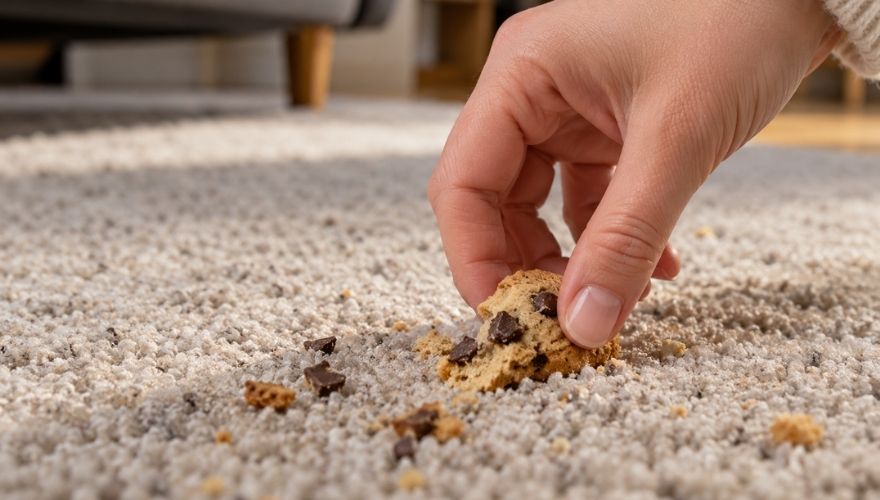
Instinct says carpet must be worse than tile. Carpet looks harder to clean, collects dust, and has a habit of revealing crumbs you thought vanished months ago.
Smooth surfaces such as tile and stainless steel can create broad, direct contact with food.
Carpet may transfer fewer bacteria in some tests because less of the food touches the contaminated material at once.
A rug can look like the obvious villain while transferring less bacteria during a controlled experiment. That is not quite the same thing as recommending you retrieve a meatball hiding under the coffee table.
Surface type matters, but contamination level matters more.
Clean-looking tile can carry microbes. Visibly messy flooring can vary in what is actually present. Eyes are useful for spotting crumbs and mud, but they are not microbiology equipment.
Your Floor Has a History
Dropped-food decisions usually focus on the moment itself. You look at the floor, look at the food, and make a judgment based on what both look like right now.
Microbes have longer memories.
Bacteria can persist on surfaces after the original contamination event has passed. Experiments have shown transfer hours after a surface was first contaminated, with some bacteria still capable of moving onto food roughly a day later.
Salmonella has also survived on dry surfaces for extended periods under controlled conditions. One Clemson experiment still found Salmonella on tile 28 days after contamination, with enough bacteria surviving to make later transfer possible.
A kitchen floor can collect more than yesterday’s cereal crumbs. Shoes, pet paws, dust, grocery bags, luggage, and whatever came in through the doorway all contribute to its history.
Your cucumber does not care that you mopped yesterday if something unpleasant walked across the kitchen afterward.
Looks can still help with obvious hazards, but a spotless patch of floor is not automatically sterile. Cleanliness is partly visible and partly not.
Can You Just Rinse It?
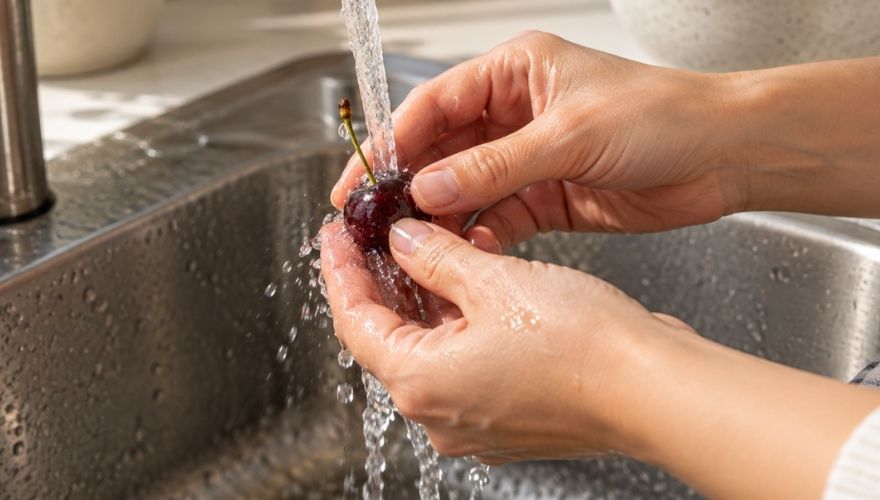
Sometimes washing makes sense.
A dropped cherry, carrot, or similar food can be rinsed properly without ruining it. Running water may remove some microorganisms sitting on the surface.
Other foods make the idea slightly ridiculous.
Trying to wash a cracker back to innocence is not going to improve anyone’s afternoon. Chicken wings, buttered toast, pastries, and other foods that absorb water or hold sauce do not become reassuring just because they spent two seconds under a faucet.
Rinsing also does not guarantee that every microorganism is gone. Water can reduce contamination, but it is not an undo button.
Practical judgment matters here. A firm carrot that can be washed thoroughly is a different proposition from a wet slice of melon that landed face down beside the trash can.
Retire the Stopwatch
Five seconds became popular because it turns a messy judgment into a clean number.
Real contamination is much less cooperative.
Bacteria can transfer almost immediately. Moisture changes how easily that happens. Food type matters. Surface type matters. Surface history matters. Contact time matters too, just not in the reassuring way the rule suggests.
None of that means every dropped bite is headed straight for disaster. Contamination varies, and risk varies with it.
So yes, what you dropped matters. A cracker and a slice of watermelon really are having different experiences down there.
Five seconds is simply the wrong question.
If you want to know how nervous to be about that fallen bite, look at the food first.