
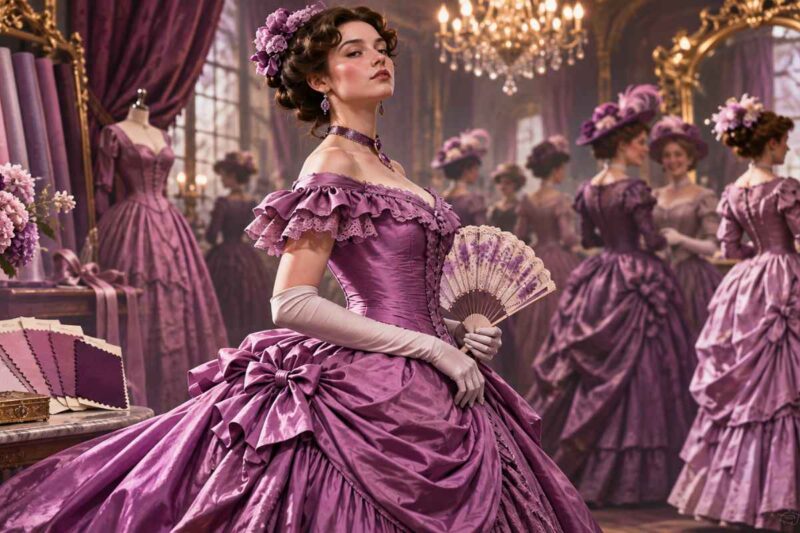
Imagine walking into a Victorian ballroom and discovering that half the women had apparently agreed to wear the same color. Purple silk everywhere, enormous skirts competing for space, and a fashionable shade called mauve suddenly appearing on practically everyone who could afford it.
By the late 1850s, mauve had become one of Europe’s most desirable fashion colors. Royal women wore it, fashionable society followed, and newspapers began noticing just how enthusiastic everyone had become about purple.
Strangely, none of it started with a dressmaker or a designer.
An 18-year-old chemistry student named William Henry Perkin had accidentally created the synthetic dye in 1856 while attempting to produce a treatment for malaria. His experiment failed spectacularly at its intended purpose, but the unexpected result would change the clothing industry.
Sometimes fashion’s next big idea arrives wearing a laboratory coat.
In this article
A Failed Experiment Created Fashion’s Next Favorite Color
View this post on Instagram
Back in 1856, William Henry Perkin was studying chemistry at London’s Royal College of Chemistry under August Wilhelm von Hofmann.
His assignment involved an ambitious scientific challenge: producing synthetic quinine, a valuable treatment for malaria that was traditionally extracted using cinchona bark.
During the Easter vacation, Perkin continued experimenting in a makeshift laboratory at his family’s home.
Working with chemicals associated with coal tar, a byproduct of gas production, he attempted to create quinine through chemical reactions. An early experiment failed, and another involving aniline and potassium dichromate produced an unpleasant dark substance.
Most people would have considered the resulting black material a reason to clean the equipment and try again.
Perkin became curious.
When he treated the material with alcohol, he obtained a striking purple solution. More importantly, it could color silk in a shade that showed promising resistance to washing and exposure to light.
As documented in the Science History Institute’s collection of Perkin’s original patent specification, he secured a British patent for his discovery in 1856.
Perkin secured British patent No. 1984 on August 26, 1856, at just 18 years old. Most teenagers were still figuring out what to do with their lives. Perkin had already patented a color that would soon appear in some of Europe’s most fashionable wardrobes.
His invention, eventually called mauveine, became the first commercially successful synthetic organic dye.
Curious how one failed chemistry experiment changed the history of fashion? Watch this short video from the Science Museum to discover how William Henry Perkin accidentally created the purple dye that took Victorian society by storm.
Why Purple Was Such a Big Deal
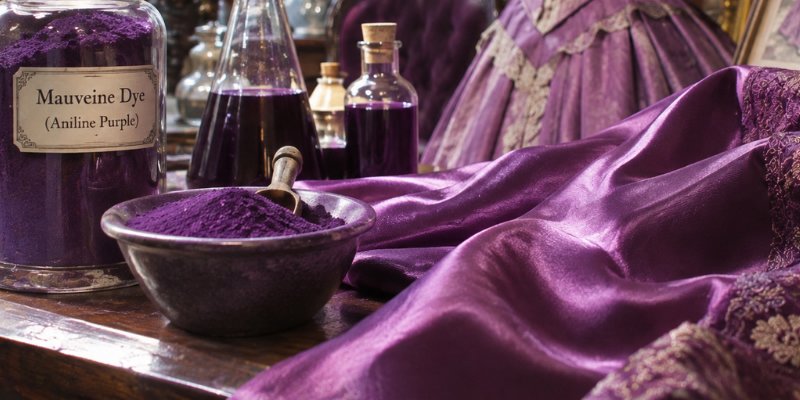
Purple already had serious social credentials before Perkin entered the picture.
For centuries, obtaining certain purple dyes had been expensive and labor-intensive. Famous examples included Tyrian purple, historically produced using marine mollusks and associated with elite clothing.
Other purple shades could be created using natural dyes, but producing attractive, consistent colors presented challenges.
Perkin’s discovery offered manufacturers a new possibility.
Rather than depending entirely on natural coloring materials, textile producers could manufacture a purple dye using industrial chemical processes.
An important distinction deserves attention here. Mauve was not the first purple fabric color, and early synthetic dyes were not automatically cheap enough for every household. Their advantage involved the potential for increasingly consistent, large-scale production at lower costs.
Perkin recognized that commercial potential almost immediately.
With financial backing and practical assistance provided by his father and brother, he established a factory at Greenford Green, near London.
By December 1857, Perkin and Sons was supplying mauve dye to silk manufacturers.
A failed attempt at producing medicine had become a functioning chemical business in less than two years.
How Mauve Became the Color of Victorian High Society
Of course, inventing a color and convincing fashionable women to wear it are two very different accomplishments.
Perkin had solved the chemistry problem. Fashion needed someone influential to make the color desirable.
Fortunately for his business, European royalty provided exactly that.
Empress Eugénie of France, wife of Napoleon III and one of the period’s most influential fashion figures, developed an enthusiasm for mauve. Her association with the shade helped establish its reputation among fashionable Parisian women.
Queen Victoria added another important endorsement. On January 25, 1858, Victoria wore a mauve gown to the wedding of her eldest daughter, Victoria, Princess Royal, to Prince Frederick William of Prussia.
Royal clothing attracted considerable attention, and the appearance of such a fashionable color at a major wedding gave mauve additional visibility.
For Victorian women following aristocratic fashion, its popularity suddenly had excellent credentials.
Why Mauve Worked So Well With Victorian Dresses
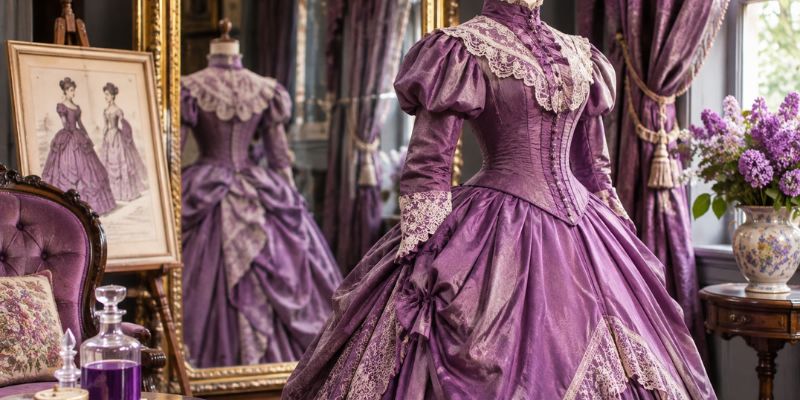
Timing played an important part in the craze.
During the late 1850s, fashionable women’s dresses frequently featured voluminous skirts supported by crinolines. Large expanses of silk provided plenty of space for displaying vivid colors.
Mauve was especially effective on these elaborate garments because its purple tones offered something noticeably different compared with many conventional dress colors.
Its novelty was also part of its attraction.
Consider the practical difference between admiring a fashionable color and actually purchasing a dress in it. A successful trend required textile manufacturers to supply the shade consistently, dressmakers to work with the resulting fabrics, and customers to see desirable examples worn by influential women.
Perkin’s factory addressed the manufacturing side, while royal fashion helped create demand.
Physical evidence of that commercial success survives.
An 1862-1863 silk skirt and blouse preserved by the Science Museum Group was colored using Perkin’s synthetic dye.
However, historians face an interesting complication. Not every purple Victorian garment necessarily contained mauveine. Other natural and synthetic dyes produced similar colors, making chemical identification important when examining historical clothing.
A fashionable shade and a particular chemical dye are not always the same thing.
Mauve Mania Became So Popular It Was Almost a Joke
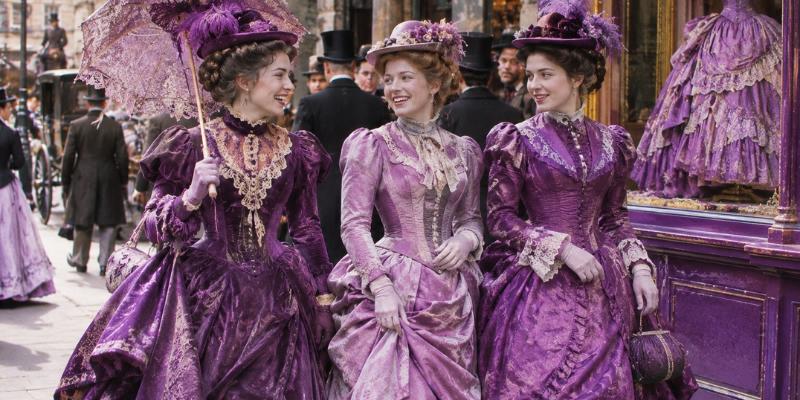
By 1859, mauve had moved well past the stage of being an interesting new color.
It was becoming difficult to avoid.
Purple appeared on dresses, ribbons, gloves, accessories, and other fashionable items. A shade initially associated with stylish women and royal approval was gaining a much wider audience.
Naturally, Victorian society eventually began making fun of itself. In 1859, the satirical magazine Punch mocked the obsession by describing it as “mauve’s measles,” treating the spread of purple clothing almost like a contagious illness.
One could hardly ask for better evidence that a fashion trend had become excessive.
According to the Ashmolean Museum’s examination of Victorian fashion, the period saw an extraordinary expansion of fashionable clothing colors as synthetic dyes became commercially available.
Mauve was among the earliest and most conspicuous examples.
A Fashion Trend With an Unlikely Origin
Today, mauve is an ordinary clothing color. You might find it on a summer dress, a sweater, or a pair of curtains without giving its origins much thought.
Victorian shoppers encountered something considerably more exciting.
A color associated with fashionable royalty had become available through a new industrial process, allowing manufacturers to supply a shade that captured public attention with remarkable speed.
Perkin never managed to produce quinine during those experiments. Instead, he discovered something that helped reshape textile manufacturing and encouraged an entirely new field of industrial chemistry.
Mauve’s fashionable moment was relatively brief, but the manufacturing possibilities it introduced proved far more enduring.
And it all happened because an 18-year-old chemist noticed something interesting in an experiment that hadn’t gone according to plan.