
Your Thanksgiving turkey is safely tucked into the freezer, the menu is coming together, and everything seems under control. Except that 20-pound bird needs up to five days to thaw in the refrigerator.
For Thanksgiving 2026, a 20-pound frozen turkey should move into the refrigerator by Saturday, November 21. A 16-pound bird needs to go in by Sunday, November 22, while a 12-pound turkey can generally wait until Monday, November 23.
According to the CDC’s turkey preparation guidance, frozen turkey needs approximately 24 hours of refrigerator thawing for every 4 to 5 pounds.
Cold air gradually transfers heat into the bird, allowing the frozen meat to thaw while staying at a safe temperature. Since larger turkeys have more mass, their centers take considerably longer to thaw completely.
Your refrigerator must maintain a temperature of 40°F or below throughout the process.
In this article
Frozen Turkey Thawing Chart – Your Thursday Countdown
For Thanksgiving on Thursday, November 26, 2026, here’s when your turkey should leave the freezer.
| Turkey weight | Fridge thawing time | Move to fridge by |
| 4-8 pounds | 1-2 days | Tuesday, Nov. 24 |
| 8-12 pounds | 2-3 days | Monday, Nov. 23 |
| 12-16 pounds | 3-4 days | Sunday, Nov. 22 |
| 16-20 pounds | 4-5 days | Saturday, Nov. 21 |
| 20-24 pounds | 5-6 days | Friday, Nov. 20 |
Dates use the conservative end of the USDA’s recommended thawing ranges and assume Thursday cooking at approximately the same time of day.
For turkeys near the upper end of a weight range, choose the earlier date. A bird weighing exactly 20 pounds, for example, is better treated as a five-day thawing project than a four-day one.
Why Giving Your Turkey an Extra Day Is Usually Worth It
A turkey can feel surprisingly soft on the outside while its center is still frozen.
Refrigerator temperatures also vary. A bird thawing at 35°F may take longer than one sitting in a refrigerator closer to 40°F, even though both temperatures are safe.
Consider a family planning to dry-brine a 16-pound turkey on Wednesday evening. Moving it into the refrigerator on Sunday gives it approximately three and a half days to thaw before seasoning begins. If the center is still icy, that preparation schedule suddenly becomes less convenient.
Starting Saturday offers additional flexibility.
However, there’s a catch that deserves more attention than it usually gets: extra thawing time doesn’t mean unlimited refrigerator storage.
USDA food safety guidance specifies that a turkey thawed in the refrigerator should be cooked within one to two days after it has completely thawed.
That distinction matters when planning a dry brine. Seasoning can happen during the final refrigerated preparation period, but it doesn’t extend the turkey’s safe storage window.
Aim for enough time to thaw completely, plus a little preparation room, without turning a five-day countdown into an unnecessarily long stay in the refrigerator.
Where You Put the Turkey in the Fridge Matters, Too
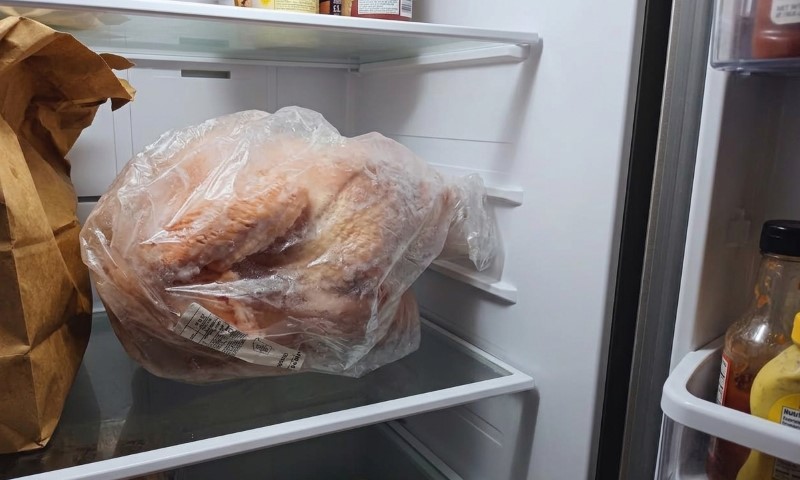
Thanksgiving refrigerators tend to become crowded before anyone has started cooking.
Between the cranberry sauce, vegetables, desserts, and ingredients waiting for their turn, finding space for a large turkey can become a small organizational project.
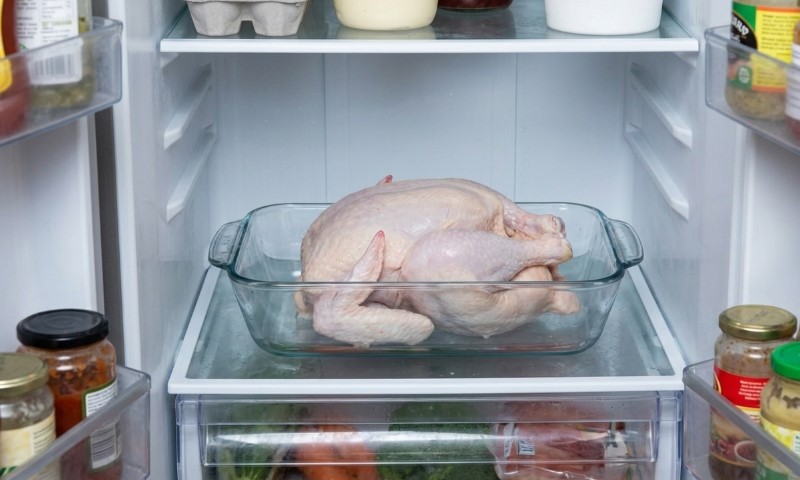
Keep the bird in its original packaging and place it inside a rimmed roasting pan or another container large enough to catch leaking juices.
Position that container on the lowest refrigerator shelf, away from uncovered produce and foods that won’t be cooked.
Such precautions help prevent raw poultry juices from contaminating other ingredients.
A separate refrigerator thermometer is useful, particularly when the appliance is packed, and its temperature setting doesn’t display an actual reading.
Using an ordinary cooler instead might sound convenient, but it isn’t automatically safe.
Unless you can reliably maintain and monitor a temperature of 40°F or below, the cooler isn’t a suitable substitute for refrigerator thawing.
Forgot to Thaw It? There’s Still a Safe Backup Plan
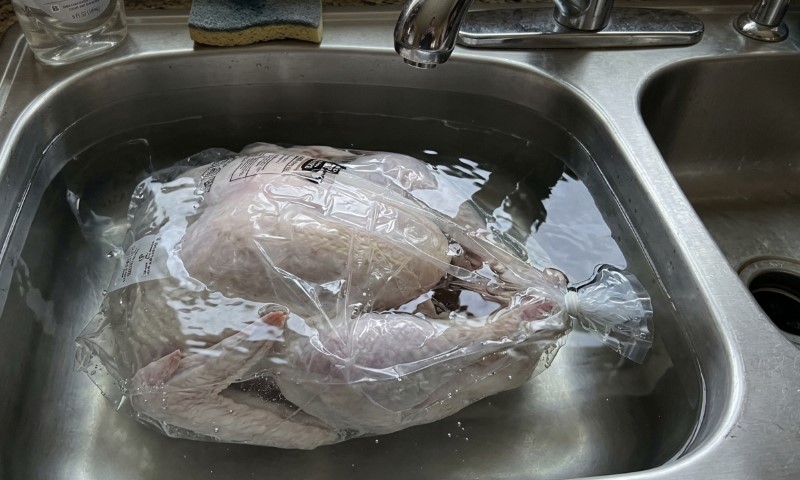
Discovering a frozen turkey on Wednesday doesn’t necessarily mean abandoning Thursday’s dinner.
And if the turkey situation gets more complicated than expected, there’s another option besides guessing. The Butterball Turkey Talk-Line connects Thanksgiving cooks with experts who can help troubleshoot everything from thawing questions to cooking problems.
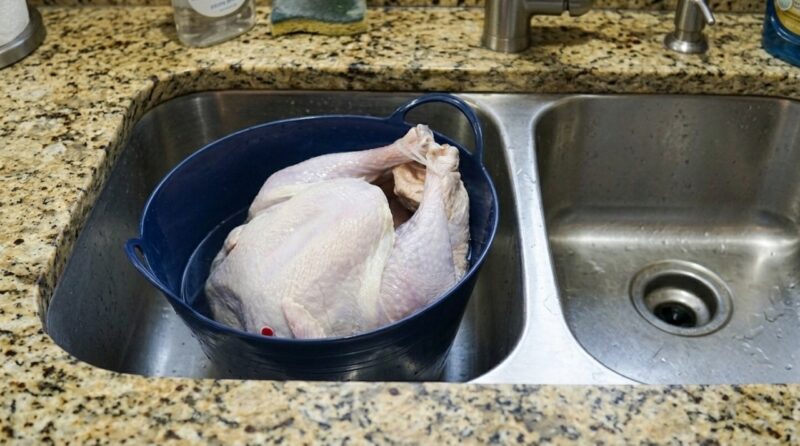
Cold-water thawing is considerably faster, although it requires more attention.
USDA instructions allow approximately 30 minutes per pound using cold tap water. That means a 16-pound turkey needs around eight hours, while a 20-pound bird requires approximately ten.
Keep the turkey inside leak-proof packaging and submerge it completely in a sink or sufficiently large container filled with cold tap water. Replace the water every 30 minutes throughout the process.
Once the turkey has thawed, cook it immediately. Unlike refrigerator thawing, the cold-water method doesn’t provide an additional day or two for storage.
One tempting shortcut should stay off the Thanksgiving schedule: leaving the bird on the kitchen counter.
Even when its center is frozen solid, the outer portions can warm into temperatures that allow harmful bacteria to multiply. Cold-water thawing works because regular water changes help keep the process controlled.
A turkey can also be cooked while still frozen, although USDA guidance indicates that cooking generally takes approximately 50% longer. Properly checking its internal temperature is essential.
And When Should You Actually Buy the Turkey?
Frozen turkey gives shoppers considerable flexibility.
You can buy one week or months ahead of Thanksgiving and keep it in a freezer maintained at 0°F or below until the appropriate thawing date.
According to the USDA’s turkey storage recommendations, a frozen raw turkey maintains its best quality for approximately one year. Continuous freezing at a safe temperature preserves food safety for longer, although quality can gradually decline.
Last-minute shoppers can move a frozen turkey directly into the refrigerator after buying it, provided enough thawing time is available.
Fresh turkey works differently. Since no thawing is necessary, USDA recommendations generally call for purchasing it only one or two days before cooking, unless its labeling provides an appropriate later use-by date.
For Thanksgiving 2026, that makes Tuesday, November 24, or Wednesday, November 25, sensible shopping days for a typical fresh bird.
Buying frozen early is convenient. Remembering to move it out of the freezer is what makes that convenience useful.
And perhaps the most underrated Thanksgiving preparation happens before anyone touches a roasting pan: clearing enough refrigerator space for a turkey that needs several days to get ready.