

You can make a sandwich in five minutes, eat it standing over the kitchen counter, and barely think about what you’re doing.
But the name of this everyday lunch comes courtesy of an 18th-century English aristocrat who supposedly couldn’t stop gambling long enough to eat dinner.
November 3 is National Sandwich Day, a date associated with John Montagu, the 4th Earl of Sandwich.
Montagu didn’t invent the idea of putting food between bread. And historians aren’t entirely convinced about the gambling story, either.
In this article
The Earl Who Gave the Sandwich Its Name
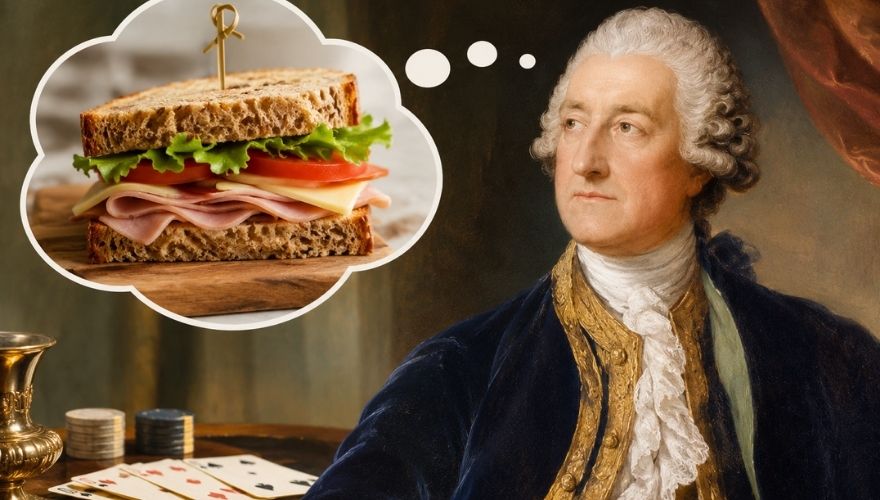
John Montagu (1718-1792) was a British nobleman and politician who held several government positions, including First Lord of the Admiralty.
According to the popular account, Montagu was an enthusiastic gambler who disliked interrupting his card games for meals.
During one lengthy session, he supposedly requested meat between two slices of bread. It allowed him to eat without utensils or getting his cards greasy.
Other gentlemen reportedly began ordering the same thing, and the food became associated with his aristocratic title.
Sandwich was already the name of an English town in Kent and Montagu’s inherited title. He didn’t invent the word for his meal.
His connection to the food became considerably more famous than his political career.
But Was He Really Too Busy Gambling to Eat?
Historians have questioned the gambling explanation, which was popularized by French travel writer Pierre-Jean Grosley during the 18th century.
Montagu’s biographer, N. A. M. Rodger, suggested another possibility. Montagu may have requested the convenient meal while working long hours at his desk.
A historical reference confirms that sandwiches were already familiar in London society by 1762.
One detail is better documented than the gambling story. On November 24, 1762, historian Edward Gibbon recorded seeing fashionable London gentlemen eating cold meat or sandwiches at the Cocoa Tree.
His journal confirms that the name was already in use, although it tells us nothing about Montagu’s supposed card game.
On November 24 that year, historian Edward Gibbon recorded seeing people eating cold meat or sandwiches at the Cocoa Tree, a fashionable London establishment.
His journal establishes that the name was in use during Montagu’s lifetime, but it doesn’t explain how the food acquired it.
Neither the gambling story nor the working-at-his-desk explanation has been conclusively established.
Both accounts have something in common, though. Montagu supposedly wanted to eat without interrupting whatever occupied his attention.
The gambling version makes a better story. The working-through-lunch version sounds suspiciously like a modern Tuesday.
People Were Eating Sandwiches Long Before Sandwich
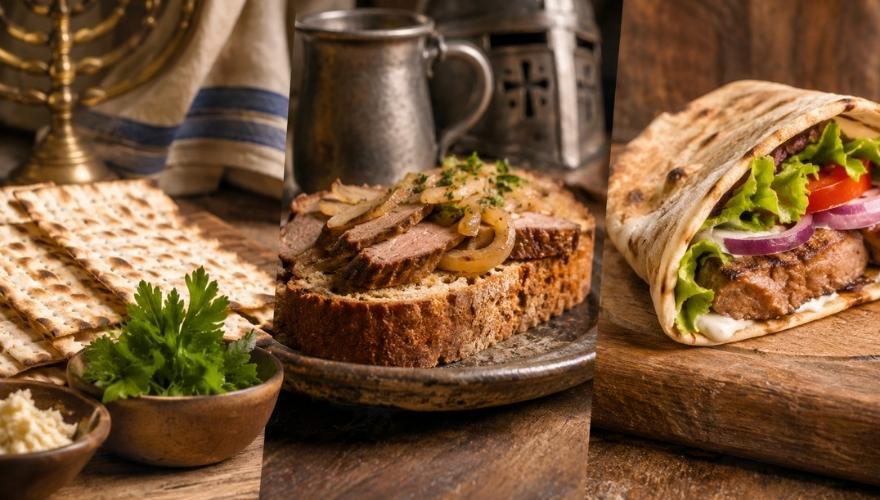
Montagu’s association with the name doesn’t make him the inventor of eating food between bread.
Centuries earlier, Jewish religious tradition associated Hillel the Elder, who lived around the first century BCE and first century CE, with combining matzah, bitter herbs, and the Passover offering.
A related preparation, known as korech, continues during Passover Seders.
These weren’t necessarily sandwiches as we define them today, but they establish that combining bread with other foods was hardly an 18th-century innovation.
Montagu’s contribution was the name associated with the modern sandwich, not the invention of the underlying idea.
How a Nobleman’s Snack Became Everyone’s Lunch
Sandwiches became popular for much the same reason Montagu supposedly enjoyed them. They’re convenient, portable, and easy to adapt.
Workers could carry them to factories, students could pack them for school, and travelers could eat without stopping for a formal meal.
Different cultures also developed their own recognizable variations.
American favorites include peanut butter and jelly and grilled cheese. Vietnam’s bánh mì combines French-influenced baguettes with Vietnamese ingredients such as pickled vegetables, herbs, and meat.
Cuban sandwiches typically feature pork, ham, Swiss cheese, pickles, and mustard pressed inside Cuban bread.
New Orleans’ po’ boy has working-class roots and commonly features fried seafood or roast beef.
Each variation uses familiar ingredients and local food traditions to make something practical and satisfying.
Even the simplest sandwich benefits from a little planning. Moist ingredients such as tomatoes and dressings can make packed bread soggy, so keeping them separate until lunchtime often produces a better result.
A Simple Food That Still Finds Ways to Surprise Us
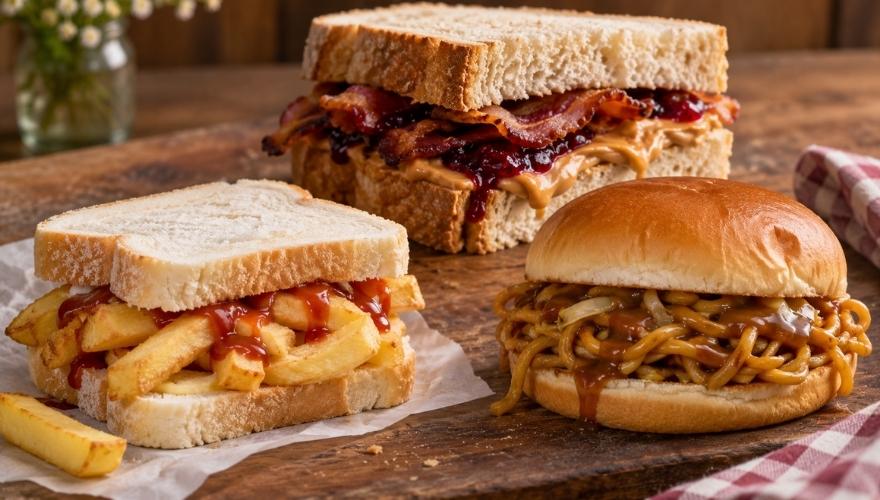
Not every sandwich follows the familiar meat-and-cheese formula.
Britain’s chip butty puts French fries between slices of bread or inside a bread roll, usually with butter or sauce.
Fall River, Massachusetts, has an even stranger example. During the early 20th century, Chinese immigrant restaurant owners popularized the chow mein sandwich, putting noodles and gravy on a hamburger bun.
Originally sold for just five cents, it offered local textile workers an inexpensive, filling meal. Not exactly what most people picture when ordering a sandwich, but practicality was always part of the idea.
Another unusual example is the Fool’s Gold Loaf, associated with Elvis Presley. It combines peanut butter, preserves, and bacon inside a large loaf of bread.
Such variations show how loosely the sandwich format can be interpreted, even when the finished meal isn’t particularly easy to eat by hand.
The Name Stuck. So Did the Idea.
National Sandwich Day is observed on November 3, traditionally identified as Montagu’s birthday in 1718.
There’s a small complication. Some historical accounts give his birthday as November 13, a discrepancy consistent with differences between historical calendar systems.
His association with the sandwich is much clearer than either his exact birthday in modern dating or the circumstances behind the food’s name.
Montagu may not have invented lunch between two slices of bread. But more than 230 years after his death in 1792, his name is still on menus around the world.
Not bad for someone who apparently just wanted to eat without stopping what he was doing.